

REQUEST FOR QUALIFICATIONS (RFQ)
Water Quality Monitoring
Upper Saluda Source Water Protection Project
Save Our Saluda is seeking an experienced consultant to conduct water quality sampling and analysis of PFAS and cyanotoxins in surface waters for the Upper Saluda Source Water Protection Project.
Statements of qualifications must be delivered electronically in PDF format via email to This email address is being protected from spambots. You need JavaScript enabled to view it. with the subject line:
“Upper Saluda Watershed EC-SDC Water Quality Monitoring Services SOQ.”
SOQs must be received no later than 5:00 p.m. ET on October 16, 2026.
Questions regarding this RFQ may be submitted to: This email address is being protected from spambots. You need JavaScript enabled to view it. by October 9, 2026. Save Our Saluda cannot provide individual feedback on questions.
Responses to questions are given at the end of this RFQ.
TABLE OF CONTENTS
RFQ for Upper Saluda Water Quality Monitoring Services
1. Project Background
2. Anticipated Process and Project Schedule
3. Scope of Services
4. Requested Qualifications
5. Submission Requirements
6. Qualifications Evaluation
7. Conditions and Limitations
1. Project Background
Save Our Saluda is a nonprofit organization dedicated to protecting and restoring the Upper Saluda Watershed, promoting clean and sustainable river flows, identifying threats facing the river and its tributaries, and seeking effective solutions in cooperation with partnering organizations and volunteers.
Save Our Saluda is working cooperatively with Easley Combined Utilities and other partners to protect and enhance drinking water quality through the Upper Saluda Source Water Protection Project. The project is funded through a grant from the South Carolina Department of Environmental Services (SCDES) and includes identification and quantification of per- and polyfluoroalkyl substances (PFAS) and cyanotoxins in surface waters of the Upper Saluda Watershed upstream of and including Saluda Lake.
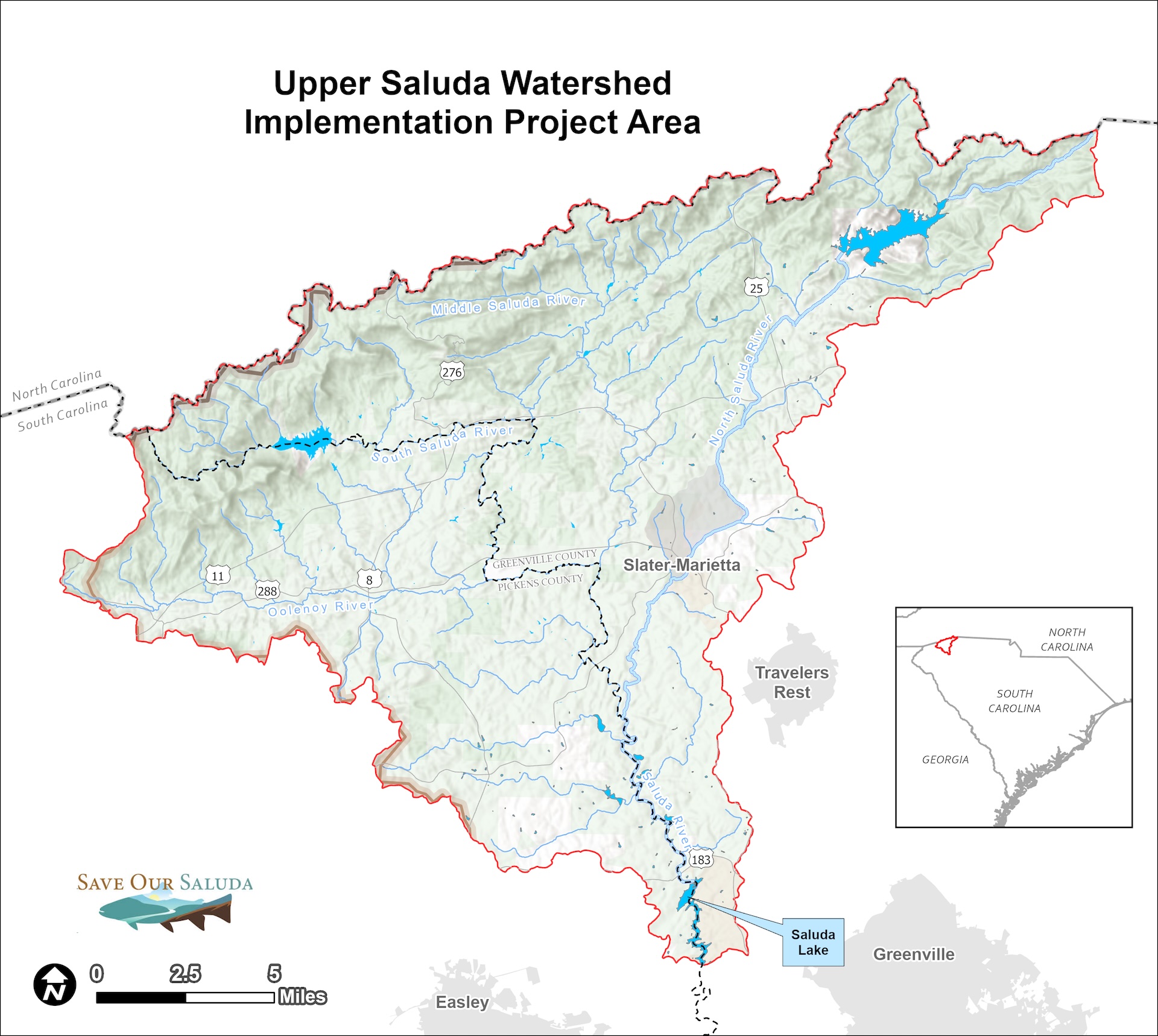
The Upper Saluda Watershed encompasses areas in northwest Greenville County and northeast Pickens County, South Carolina. Headwaters originate in the Blue Ridge Mountains and drain south to Saluda Lake, which serves as the drinking water source for Easley and surrounding communities (see map below).
Save Our Saluda is seeking an experienced consultant to conduct water quality sampling and analysis of PFAS and cyanotoxins in surface waters in the Upper Saluda Watershed. The consultant will help Save Our Saluda finalize the sampling approach and be responsible for all data collection and contracting/coordination with a laboratory, as applicable. The data collection may require field staff with ability to mobilize on short notice for collection of stormflow sampling across the watershed.
1. Anticipated Process and Project Schedule
· October 2, 2026: RFQ Issued.
· October 9, 2026: Question Period Ends at 5:00 pm.
· October 16, 2026: Responses to the RFQ due by 5:00 pm.
· October 19-October 23, 2026: Review committee reviews submitted proposals and schedules respondent interviews*.
· October 26, 2026: Proposal selection confirmed. Save Our Saluda initiates contract with the selected contractor.
· November 2, 2026: Estimated project start.
· November 16, 2026: Deadline to prepare and submit SAP to SCDES
· December 2026 – July 2028: Conduct monitoring per the approved SAP.
· July 2028: Submit monitoring analysis report to Save Our Saluda. Present findings to Save Our Saluda and partners.
· August 2028: Provide technical support and assistance with data analysis and interpretation as needed until the end of the grant term.
* The Evaluation Team may elect to interview one or more proposing companies before making an award. This committee will review each compliant submittal and may invite respondents for interviews, but this is not a required step in the selection process.
2. Scope of Services
The following is a list of the primary services to be provided by the consultant:
· Work with Save Our Saluda and utilities to review and finalize the proposed PFAS (14) and cyanotoxins (3) monitoring locations based on their downstream proximity to agricultural properties, industrial or municipal discharge sites, etc.
· Develop the data collection approach. Prepare a Sampling and Analysis Plan (SAP) and ensure successful approval of the SAP by SCDES.
· Collect in-stream PFAS samples quarterly for 2 years and cyanotoxin samples monthly between March and November for 2 years. Note, because of the grant timing, there may not be a full 2 years of sampling.
· Contract and coordinate laboratory analyses. All samples collected must be analyzed according to the SCDES-approved SAP.
· Analyze monitoring results for trends and correlation with potential sources. Develop summary report of key findings.
The final scope of services and fee will be negotiated with the highest-ranked respondent prior to contract execution.
3. Requested Qualifications
The Consultant must demonstrate the following qualifications, at a minimum:
· Experience developing and executing Sampling and Analysis Plans for PFAS and cyanobacteria.
· Experience with conducting PFAS and cyanobacteria water quality monitoring in the Upstate of South Carolina.
· Experience providing data interpretation based on monitoring results of PFAS and cyanobacteria.
4. Submission Requirements
At a minimum, submittals should include the following to help address the qualifications listed above. The submission shall be limited to 10 double-spaced pages, excluding cover page and table of contents, with a minimum size 10 font.
· Project descriptions highlighting similar work within the last 5 years by the consultant and proposed project team. Clearly demonstrate where past work meets the above-referenced qualifications. Proposers should include 3 project descriptions, maximum 1 page per project.
· Organizational chart and resumes for key members of the proposed project team (Maximum 1 page/person).
· The name, email, address, and telephone number of at least three (3) references familiar with the quality of work done by the consultant of a similar nature as contained in the above Scope of Services. By submitting the references, you are authorizing Save Our Saluda to contact these references.
· History of past experience working with any proposed sub-contractors, including a laboratory (if your response includes sub-contractors). (Maximum 1 page/sub-contractor).
· A proposed approach that addresses Save Our Saluda’s EC-SDC Grant scope outlined in this RFQ (Maximum 2 pages).
· The name, email address, mailing address, and telephone number for the respondent contact. Also include the firm/consultant’s name, physical address, and website URL.
Cost proposal is not required. Costs will be negotiated with selected contractor.
5. Qualifications Evaluation
Proposals will be evaluated on the information submitted in the proposal package as well as on other available information. Save Our Saluda may conduct interviews or investigations as deemed necessary to assist in the evaluation of any proposal and to establish the qualifications of any respondent. The following criteria will be used to evaluate proposals.
|
Criteria |
Points |
|
Overall Qualifications of the Firm/Staff. |
30 |
|
Demonstrated Experience with Technical Aspects of Requested Scope |
30 |
|
Demonstrated Understanding of the Project Scope and Expected Deliverables |
15 |
|
Firm/Staff Location, Availability, and Flexibility |
15 |
|
References |
10 |
The award will be made to the highest technically ranked consultant whose offer is determined to be the most advantageous to the project goals. All proposal requirements must be met, or be capable of being met, by the consultant. If not, the proposal will be disqualified.
All inquiries and correspondence relating to or referring to this RFP as well as all submitted materials will become the property of Save Our Saluda. All proposals will be subject to public disclosure unless exempted by law. Unless required by law, proprietary or financial information submitted as a result of this RFQ will not be disclosed if the information is noticeably marked “Confidential.”
6. Conditions and Limitations
Save Our Saluda reserves the right to reject, at its sole discretion, any and all responses to the RFQ, reissue a subsequent RFQ, terminate, restructure, or amend this process at any time, or to accept any response deemed to be in the best interest of Save Our Saluda’s goals. The ultimate selection and contract negotiation lies solely with Save Our Saluda. Save Our Saluda does not commit to pay for costs incurred in the submission of a response to this request or for any cost incurred prior to the execution of a final contract. Upon selection, an official contract shall be prepared, negotiated and fully executed before work is initiated. At the time the proposed contract is negotiated, the offeror and the Evaluation Committee may negotiate any changes desired in the scope if deemed in the best interest of Save Our Saluda. If a satisfactory proposed contract cannot be negotiated with the highest qualified bidder, negotiations will be formally terminated. Negotiations shall then be undertaken with the second most qualified offeror and so on.
The selected offeror will be required to comply with all applicable federal, state, and local laws, regulations, permits, insurance requirements, and contractual provisions.
6.1. Ownership of Proposal Documentation
Upon receipt of the proposal by the Save Our Saluda organization, the proposal and all accompanying documentation will become the property of Save Our Saluda, without compensation to the bidder, for disposition or use by the organization at its discretion. Save Our Saluda assumes no responsibility or obligation to bidders and will make no payment of any cost incurred in the preparation or submission of the proposal(s).
6.2. Acceptance Period
Any proposal in response to the RFP will be valid for sixty (60) calendar days. At the end of this period, the proposal may be withdrawn at the written request of the bidder submitting the proposal if no award has been made. If the RFP is not withdrawn at that time, the entire proposal shall remain in effect.
6.3. Contract
Upon award by Save Our Saluda, the consultant shall agree to deliver services in accordance with the terms and conditions set forth therein and any negotiations that may occur. The consultant shall be aware of and understand that minor technical adjustments may be necessary as work progresses. Timely, quality service is critical to the continuation of work under this contract.
6.4. Confidentiality
No information, materials, or other documents submitted by a bidder shall be released or made available to any persons or entity except those assisting in this procurement process unless otherwise required by law. In addition, no proprietary or financial information submitted in response to this RFP will be disclosed if visibly marked with the word, “Confidential,” unless required by law.
6.5. Proposal and Presentation Costs
Save Our Saluda will not be in any way liable for costs incurred in the preparation, presentation, discussion, or negotiation of a proposal by respondents to this RFP.
6.6. No Contact Policy
To ensure fair consideration for all respondents, Save Our Saluda prohibits any type of communications to or with any Save Our Saluda representative during the solicitation process, except as provided in this solicitation. This includes any communications initiated by a respondent to any Save Our Saluda employee, board member, or representative evaluating or considering the response, prior to the time an award decision has been made public. Any such unauthorized contact may cause the disqualification of the respondent from this procurement transaction.
This project has been funded wholly or in part by the United States Environmental Protection Agency under assistance agreement 04D00424 to the South Carolina Department of Environmental Services. The contents of this document do not necessarily reflect the views and policies of the Environmental Protection Agency, nor does the Environmental Protection Agency endorse trade names or recommend the use of commercial products mentioned in this document, as well as any images, video, text, or other content created by generative artificial intelligence tools, nor does any such content necessarily reflect the views and policies of the Environmental Protection Agency.
Response to Questions
- What is the budget for this project?
This is not a cost proposal, but a Request for Qualifications (RFQ). Therefore, costs will not be discussed at this time.
- Are you willing to share the EDC grant application?
The pertinent sections of the grant application are given below.
- Did someone external help you with this grant application?
This question does not pertain to information requested in this RFQ.
- Do you have a preferred lab in mind for the analysis?
We do not have a preferred lab, but any lab must be certified by the South Carolina Department of Environmental Services (SCDES).
- Can the Statement of Qualifications response due date (October 16, 2026) be extended?
Unfortunately, we cannot extend the due date for the SOQ.
Existing Data Sources
Available in-stream monitoring data for nutrients, turbidity, and PFAS were requested from ReWA, ECU, Greenville County and SCDES (STORET).
ReWa has PFAS data upstream and downstream of their municipal NPDES discharge from the Slater-Marietta WWTP on the North Saluda River.
ECU collects water quality data, including daily turbidity, at their drinking water intake on Saluda Lake.
Greenville County collects water quality monitoring data from a number of continuous monitoring gages throughout the county as part of their MS4 program. Included are data for sediment and nutrients at Keeler Bridge Road on the North Saluda River and at Tilly Road on the Middle Saluda River.
SCDES (STORET) data is available for multiple monitoring sites on the North Saluda River.
Monitoring results and trends for data provided to date are included below. As part of the proposed project, existing data will be updated and augmented with new data collected at different watershed locations as described.
Cyanobacteria and Cyanotoxins
Cyanobacteria, the cyanotoxins they can produce, and the risk these pose to the development of HABs are a growing concern in lakes and reservoirs in Upstate South Carolina. Lake Greenwood is situated downstream of Saluda Lake and serves as the primary drinking water source for Greenwood County and parts of Laurens County. It was the site of a major algal bloom in 1999 and still faces challenges with nutrients from upstream development and wastewater discharges. While cyanobacteria exist naturally in aquatic environments, favorable conditions (e.g., excess phosphorus and nitrogen, high pH, high water temperature, shallower and slower moving waters) can result in the proliferation of cyanobacteria and HABs that have the potential to release cyanotoxins (Bonilla et al. 2024). As these favorable conditions develop in Saluda Lake due to sedimentation and subsequent reduction in depth of the lake, the risk of cyanotoxins and HABs in the drinking water source increases. Human ingestion of, or contact with cyanotoxins can lead to a multitude of health issues, including neurological complications, liver disease, abdominal distress, and skin and respiratory irritation (Lad et al., 2022).
PFAS
SCDES has both ambient and long-term monitoring data showing the presence of PFAS statewide. However, there are currently no SCDES PFAS monitoring stations in the Upper Saluda Watershed. The 2022-2023 report from SCDES on PFAS in South Carolina surface waters shows the six PFAS analytes the EPA is proposing to regulate in drinking water are routinely detected across the state, and that limiting the release of PFAS to the environment will provide far reaching human health and environmental benefits and reduce drinking water costs (Distributions of Per- and Polyfluoroalkyl Substances (PFAS) in South Carolina Surface Waters, 2022-2023). Research studies have shown adverse health impacts from exposure to PFAS. Examples include hepatotoxicity, decreased neurodevelopment in children, and thryroid hormone disruption (Mislanova and Valachovicova 2025). Both ECU and ReWa have conducted PFAS monitoring in the Upper Saluda Watershed. ECU PFAS data was collected at the surface water intake at Saluda Lake. ReWa PFAS data was collected upstream and downstream of the WWTP discharge pipe in the North Saluda River. These data are shown in the graphs below and indicate the presence of PFAS in the Upper Saluda Watershed (Figures 5 and 6).

Figure 5: PFAS levels at the intake of Saluda Lake (source: Easley Combined Utilities).

Figure 6: PFAS results upstream and downstream of the Slater-Marietta WWTP on the North Saluda River (source: ReWa).
The full extent of PFAS sources in the watershed draining to Saluda Lake are unknown, but there are ongoing and historic industrial NPDES discharges in the watershed are potential sources of PFAS. Other potential sources could include runoff from agricultural areas that use pesticides and any areas where there is land application of biosolids.
Water Quality Sampling and Analysis for PFAS and Cyanotoxins
Neither the SCDES Ambient Surface Water PFAS nor the SCDES Long-Term Monitoring PFAS Projects have PFAS monitoring locations within the watershed draining to Saluda Lake. ReWa and ECU have conducted limited PFAS monitoring upstream and downstream of the municipal discharge point in the North Saluda River and at the drinking water intake in Saluda Lake.
EC-SDC funding will be used to measure PFAS concentrations in surface waters draining into Saluda Lake at sites separate from existing monitoring locations. The proposed project includes 14 additional PFAS sampling locations throughout the Upper Saluda Watershed (Figure 7). Included are locations above and below potential watershed source areas and also reference sites at the outfalls of Table Rock Reservoir and North Saluda Reservoir. Each new PFAS sampling location will be sampled four times per year to gain insight into seasonal variations. Results will be used to supplement existing PFAS data collected from the other watershed locations to help identify potential source areas. Data will be available for use by other entities addressing PFAS concerns in drinking water sources and for educational purposes. Educational flyers will be developed with information about PFAS and its sources.
PFAS samples will be analyzed using Cyclopur collection devices (https://cyclopure.com/product/water-test-kit-pfas/). These water sampling kits contain a special sorbent (Dexsorb®) specifically designed for absorbing and concentrating PFAS. The company extracts the PFAS from the sorbents and analyzes 55 PFAS compounds, including all 40 compounds listed under EPA 1633, at a level of quantification of 1.0 ppt (1 ng/L).

Figure 7: Proposed monitoring locations for PFAS and cyanotoxins in the Upper Saluda Watershed.
SCDES does not conduct cyanotoxin monitoring in Saluda Lake. Therefore, cyanotoxins will be measured at three locations in Lake Saluda: at the upstream inlet, in the upper area of the lake where sedimentation is most prevalent, and in the middle of the lake near the drinking water intake. Additional sampling will be performed upon notification of algal blooms by local observers. Cyanotoxin samples will be collected between March and November on a monthly basis for the full grant period. Based on analysis of the initial results, the frequency and/or duration of sampling may be revised to capture cyanotoxin-producing algal blooms. Samples will be analyzed with an enzyme-linked immunosorbent assay (ELISA kit, Abraxis), using the same protocol as used by SCDES.
The following Table details the proposed monitoring locations displayed on Figure 7.

